The Anti-Corruption Microservice Pattern

Implement an anti-corruption microservice (ACM) to talk to an external system. Other microservices only communicate with the external system via the ACM. The ACM translates requests from the microservices system to the external system and back.

Use this pattern when you employ a microservices architecture and you want to ensure their designs are not limited by an external system. This pattern is an adaptation of the Anti-Corruption Layer (ACL) pattern for microservices architectures.

Context and problem

The context of the ACL pattern applies, but additionally, your application is made up of microservices and multiple of those communicate with the external system. If you’d only apply the ACL pattern, then you’d end up with multiple microservices that each have an ACL for the same external system.

Solution

Isolate the microservices from the external system by placing an Anti-Corruption Microservice (ACM) between them. This layer translates communications between the application’s microservices on the one hand and the external system on the other.
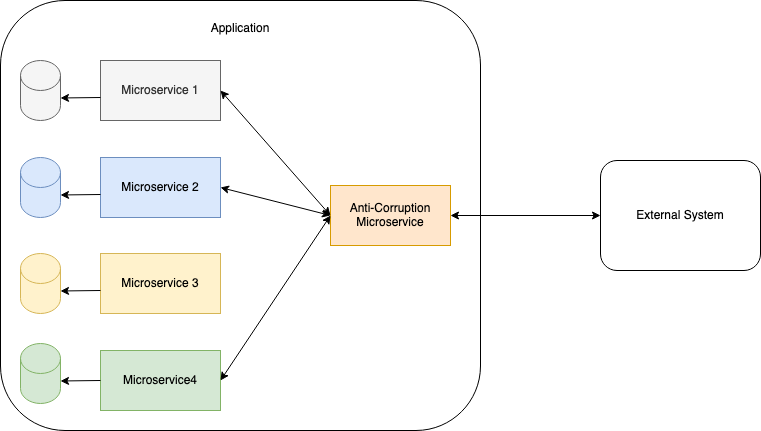
The diagram above shows an application consisting of 4 microservices, 3 of which communicate with the same external system via an Anti-Corruption Microservice. Communication between the microservices and the ACM always uses the data model and architecture of the application. Calls from the ACM to the external system conform to the external system’s data model and methods. The ACM contains all the logic necessary to translate between the two systems.

Issues and considerations

  • The ACM may add latency to calls between the two systems. Conversely, by caching data from calls by one microservice, the ACM might speed up calls by a different microservice.
  • The ACM is another microservice to be managed, maintained, and scaled.
  • The ACM doesn’t need to support all the features of the external system, just the ones used by the application’s microservices.

When to use this pattern

Use this pattern when:

  • Two or more systems have different semantics, but still need to communicate.
  • The external system is provided by a vendor and you want to minimize vendor lock-in. This elevates the idea of hexagonal architecture to the microservices world, where the ACM is a port and the external system an adapter.

Related resources

Acknowledgements

Thanks to Dev for pushing me to write up this pattern.

Too Many Open Files, Or Too Few Bounded Contexts?

A Business Men Climbing a Pile of PapersServer software needs to run unsupervised for long periods of time to be practical.

Release It! is full of horror stories about programming mistakes that get in the way of that lofty goal.

One example is opening files and forgetting to close them.

On some operating systems this will eventually lead to a Too many open files error when the number of open files passes a certain limit.

Of course we want to make sure that doesn’t happen to us. IDEs like Eclipse can give you warnings in certain cases to help with that, but if you’re test infected like me, you will want to write a test to make sure.

This is one of those situations where people less committed to (unit) testing tend to give up. There is nothing in the Java file system API that tells you how many files are open, so it simply cannot be done, right?

Not so fast, my friend!

First, with some proprietary code you can, in fact, count the number of open files in Java.

Second, we can do even better if we step back for a moment and take a look at the bigger picture. Chances are that our application isn’t really about files; that using files is simply a convenient implementation choice.

In the lingo of Eric Evans’ classic Domain-Driven Design, we have (at least) two bounded contexts: your core domain (what people buy/use your application for) and the file system.

A bounded context delimits the applicability of a particular model so that team members have a clear and shared understanding of what has to be consistent and how it relates to other contexts.

Evans describes a number of strategies for dealing with different bounded contexts. In our example, the file system API is not under our control, which rules out the majority of them. The remaining strategies are:

  • Separate Ways, i.e. use something other than the file system. That probably doesn’t make sense in this example
  • Conformist, i.e. follow the Java model slavishly. This is what most developers do without giving it much thought
  • Anti-Corruption Layer, i.e. create an isolating layer to provide clients with functionality in terms of their own domain model. This layer translates in both directions as necessary between the two models

This last strategy gives us more than “just” the opportunity to keep our models clear and to the point. By introducing interfaces that we control in our anti-corruption layer, we also gain the opportunity to mock those interfaces in our tests, making it very easy to verify that we indeed close all the files we open.

This is yet another example where difficulty in unit testing a piece of code points to an opportunity to improve the design. If we consistently act on such opportunities, we will end up with a clean architecture that is a joy to work with.