Permissions in OSGi

In a previous post, we looked at implementing a sandbox for Java applications in which we can securely run mobile code.

This post looks at how to do the same in an OSGi environment.

OSGi

The OSGi specification defines a dynamic module system for Java. As such, it’s a perfect candidate for implementing the kind of plugin system that would enable your application to dynamically add mobile code.

Security in OSGi builds on the Java 2 security architecture that we discussed earlier, so you can re-use your knowledge about code signing, etc.

OSGi goes a couple of steps further, however.

Revoking Permissions

One of the weaknesses in the Java permissions model is that you can only explicitly grant permissions, not revoke them. There are many cases where you want to allow everything except a particular special case.

There is no way to do that with standard Java permissions, but, luckily, OSGi introduces a solution.

The downside is that OSGi introduces its own syntax for specifying policies.

The following example shows how to deny PackagePermission for subpackages of com.acme.secret:

DENY {
  ( ..PackagePermission "com.acme.secret.*" "import,exportonly" )
} "denyExample"

(In this and following examples, I give the simple name of permission classes instead of the fully qualified name. I hint at that by prefixing the simple name with ..)

PackagePermission is a permission defined by OSGi for authorization of package imports and exports. Your application could use a policy like this to make sure that mobile code can’t call the classes in a given package, for instance to limit direct access to the database.

Extensible Conditions on Permissions

The second improvement that OSGi brings is that the conditions under which a permission are granted can be dynamically evaluated at runtime.

The following example shows how to conditionally grant ServicePermission:

ALLOW {
  [ ..BundleSignerCondition "* ; o=ACME" ]
  ( ..ServicePermission "..ManagedService" "register" )
} "conditionalExample"

ServicePermission is an OSGi defined permission that restricts access to OSGi services.

The condition is the part between square brackets. OSGi defines two conditions, which correspond to the signedBy and codeBase constructs in regular Java policies.

You can also define your own conditions. The specification gives detailed instructions on implementing conditions, especially with regard to performance.

Different Types of Permissions

The final innovation that OSGi brings to the Java permissions model, is that there are different types of permissions.

Bundles can specify their own permissions. This doesn’t mean that bundles can grant themselves permissions, but rather that they can specify the maximum privileges that they need to function. These permissions are called local permissions.

The OSGi framework ensures that the bundle will never have more permissions than the local permissions, thus implementing the principle of least privilege.

Actually, that statement is not entirely accurate. Every bundle will have certain permissions that they need to function in an OSGi environment, like being able to read the org.osgi.framework.* system properties.

These permissions are called implicit permissions, since every bundle will have them, whether the permissions are explicitly granted to the bundle or not.

The final type of permissions are the system permissions. These are the permissions that are granted to the bundle.

The effective permissions are the set of permissions that are checked at runtime:

effective = (local ∩ system) ∪ implicit

Local permissions enable auditing. Before installing a bundle into your OSGi environment, you can inspect the Bundle Permission Resource in OSGI-INF/permissions.perm to see what permissions the bundle requires.

If you are not comfortable with granting the bundle these permissions, you can decide to not install the bundle. The point is that you can know all of this without running the bundle and without having access to its source code.

Integration into the Java Permissions Model

The OSGi framework integrates their extended permissions model into the standard Java permissions model by subclassing ProtectionDomain.

Each bundle gets a BundleProtectionDomainImpl for this purpose.

This approach allows OSGi to tap into the standard Java permissions model that you have come to know, so you can re-use most of your skills in this area. The only thing you’ll have to re-learn, is how to write policies.

Comparison of Permission Models

To put the OSGi permission model into perspective, consider the following comparison table, which uses terminology from the XACML specification:

Permission Models Standard Java OSGi
Effects permit permit, deny
Target, Condition codeBase, signedBy codeBase, signedBy, custom conditions
Combining Algorithms first-applicable first-applicable, local/system/implicit

From this table you can see that the OSGi model is quite a bit more expressive than the standard Java permission model, although not as expressive as XACML.

Sandboxing Java Code

In a previous post, we looked at securing mobile Java code. One of the options for doing so is to run the code in a cage or sandbox.

This post explores how to set up such a sandbox for Java applications.

Security Manager

The security facility in Java that supports sandboxing is the java.lang.SecurityManager.

By default, Java runs without a SecurityManager, so you should add code to your application to enable one:

System.setSecurityManager(new SecurityManager());

You can use the standard SecurityManager, or a descendant.

The SecurityManager has a bunch of checkXXX() methods that all forward to checkPermission(permission, context). This method calls upon the AccessController to do the actual work (see below).

[The checkXXX() methods are a relic from Java 1.1.]

If a requested access is allowed, checkPermission() returns quietly. If denied, a java.lang.SecurityException is thrown.

Code that implements the sandbox should call a checkXXX method before performing a sensitive operation:

SecurityManager securityManager = System.getSecurityManager();
if (securityManager != null) {
  Permission permission = ...;
  securityManager.checkPermission(permission);
}

The JRE contains code just like that in many places.

Permissions

A permission represents access to a system resource.

In order for such access to be allowed, the corresponding permission must be explicitly granted (see below) to the code attempting the access.

Permissions derive from java.security.Permission. They have a name and an optional list of actions (in the form of comma separated string values).

Java ships with a bunch of predefined permissions, like FilePermission. You can also add your own permissions.

The following is a permission to read the file /home/remon/thesis.pdf:

Permission readPermission = new java.io.FilePermission(
    "/home/remon/thesis.pdf", "read");

You can grant a piece of code permissions to do anything and everything by granting it AllPermission. This has the same effect as running it without SecurityManager.

Policies

Permissions are granted using policies. A Policy is responsible for determining whether code has permission to perform a security-sensitive operation.

The AccessController consults the Policy to see whether a Permission is granted.

There can only be one Policy object in use at any given time. Application code can subclass Policy to provide a custom implementation.

The default implementation of Policy uses configuration files to load grants. There is a single system-wide policy file, and a single (optional) user policy file.

You can create additional policy configuration files using the PolicyTool program. Each configuration file must be encoded in UTF-8.

By default, code is granted no permissions at all. Every grant statement adds some permissions. Permissions that are granted cannot be revoked.

The following policy fragment grants code that originates from the /home/remon/code/ directory read permission to the file /home/remon/thesis.pdf:

grant codeBase "file:/home/remon/code/-" {
    permission java.io.FilePermission "/home/remon/thesis.pdf",
        "read";
};

Note that the part following codeBase is a URL, so you should always use forward slashes, even on a Windows system.

A codeBase with a trailing / matches all class files (not JAR files) in the specified directory. A codeBase with a trailing /* matches all files (both class and JAR files) contained in that directory. A codeBase with a trailing /- matches all files (both class and JAR files) in the directory and recursively all files in subdirectories contained in that directory.

For paths in file permissions on Windows systems, you need to use double backslashes (\\), since the \ is an escape character:

grant codeBase "file:/C:/Users/remon/code/-" {
    permission java.io.FilePermission
        "C:\\Users\\remon\\thesis.pdf", "read";
};

For more flexibility, you can write grants with variable parts. We already saw the codeBase wildcards. You can also substitute system properties:

grant codeBase "file:/${user.home}/code/-" {
    permission java.io.FilePermission
        "${user.home}${/}thesis.pdf", "read";
};

Note that ${/} is replaced with the path separator for your system. There is no need to use that in codeBase, since that’s a URL.

Signed Code

Of course, we should make sure that the code we use is signed, so that we know that it actually came from who we think it came from.

We can test for signatures in our policies using the signedBy clause:

keystore "my.keystore";
grant signedBy "signer.alias", codeBase ... {
  ...
};

This policy fragment uses the keystore with alias my.keystore to look up the public key certificate with alias signer.alias.

It then verifies that the executing code was signed by the private key corresponding to the public key in the found certificate.

There can be only one keystore entry.

The combination of codeBase and signedBy clauses specifies a ProtectionDomain. All classes in the same ProtectionDomain have the same permissions.

Privileged Code

Whenever a resource access is attempted, all code on the stack must have permission for that resource access, unless some code on the stack has been marked as privileged.

Marking code as privileged enables a piece of trusted code to temporarily enable access to more resources than are available directly to the code that called it. In other words, the security system will treat all callers as if they originated from the ProtectionDomain of the class that issues the privileged call, but only for the duration of the privileged call.

You make code privileged by running it inside an AccessController.doPrivileged() call:

AccessController.doPrivileged(new PrivilegedAction() {
  public Object run() {
    // ...privileged code goes here...
    return null;
  }
});

Assembling the Sandbox

Now we have all the pieces we need to assemble our sandbox:

  1. Install a SecurityManager
  2. Sign the application jars
  3. Grant all code signed by us AllPermission
  4. Add permission checks in places that mobile code may call
  5. Run the code after the permission checks in a doPrivileged() block

I’ve created a simple example on GitHub.

XACML Vendor: NextLabs

This is the third in a series of posts where I interview XACML vendors. This time we talk to NextLabs.

Why does the world need XACML? What benefits do your customers realize?

Over the last 20 years IT has focused on building walls around their networks and applications. Now with cross-organizational collaboration, cloud and mobile we are finding that those walls are no longer relevant for protecting critical information.

The world needs XACML to protect critical information in today’s collaborative business and IT environment.

At NextLabs we focus on applying Extensible Access Control Markup Language (XACML) to information protection to enable our customers to accelerate global collaboration while simultaneously protecting their most sensitive intellectual property.

Using Attribute-Based Access Control (ABAC) and externalized authorization we can protect data based on its sensitivity, defined by attributes, across applications and systems. Traditional access control models such as Role-Based Access Control (RBAC) and Access Control Lists (ACLs) simply do not scale to address the information protection problem.

What products do you have in the XACML space?

NextLabs has taken an industry-solution approach to the market. We provide several industry-solutions for regulatory compliance, secure partner collaboration, and intellectual property protection.

Each solution is comprised of pre-built policy libraries that implement industry best-practices, pre-built policy-enforcement-points (PEPs) for critical enterprise applications, our Control Center Information Control Platform based on XACML, and pre-built reporting.

Control Center is our Information Control Platform. It has several components:

  • Control Center Server – the Control Center server includes our Policy Administration Point (PAP) and additional services necessary for information control use cases. These include:
    • Information Classification Services – a compressive set of services that automate information classification such as content-analysis, data tagging, and user driven classification
    • Policy Development and Lifecycle Management Services – Services to govern and simplify the development and management of policy such as delegated administration, approval workflow, testing and validation, audit trail, versioning, and dictionary services. On top of this we provide Policy Studio, a graphical policy integrated development environment (IDE)
    • Policy Deployment and PDP Management Services – services that allow us to reliably deploy policies to distributed PDPs, even over the public internet
    • Audit and Reporting Services – role-based dashboards, analytics, and reporting to provide insights into information activity and policy compliance
  • Control Center Policy Controller – the Policy Controller is our policy-decision-point (PDP). We provide three different editions of the Policy Controller:
    • Endpoint Policy Controller – designed to run on laptops and desktops, even when disconnected
    • Server Policy Controller – designed to run co-located with a server based applications. Can be run as a service/daemon or embedded into an application
    • Policy Controller Service – designed to run as a stand-alone PDP service in J2EE Application Server

NextLabs provides over a dozen pre-built Policy Enforcement Points (PEPs) for common applications and system. These are separated into three product lines:

  • Entitlement Management – pre-built PEPs for server applications, including:
    • Document Management (Microsoft SharePoint, SAP Document Management)
    • SAP Enterprise Resource Planning
    • Product Lifecycle Management (SAP PLM, Dassault Enovia)
    • Collaboration (CIFS and NFS File Servers)
  • Collaborative Rights Management – Collaborative Rights Management (cRM) applies XACML to protect unstructured data (files)
  • Data Protection – Data Protection is a suite of endpoint PEPs for removable devices, networking, email applications, web meeting applications and unified communication applications

What versions of the spec do you support? What optional parts? What profiles?

We support the core 2.0 and 3.0 specifications as well as the SAML, EC-US and IPC profiles.

What sets your product apart from the competition?

At NextLabs we differentiate ourselves through comprehensive industry solutions and our focus on information protection.

XACML is a generic authorization standard and can be applied to many things. Making it useful to the business buyer requires significant work beyond the standard – resources need attributes (i.e. information needs to be classified), PEPs need to be built, obligations/advise need to be implemented and policies need to be designed, developed and tested.

We have addressed this solution gap to make XACML useful for protecting critical information, and that’s what sets us apart.

What customers use your product? What is your biggest deployment?

NextLabs works with leading companies in the Manufacturing, High-Tech, Aerospace and Defense, Chemical, Energy, and Industrial Equipment industries. These companies typically have very high-value or sensitive intellectual property, global operations and are subject to strict global regulations.

We have multiple deployments above 50,000 users and have a project that will soon reach 100,000 users.

We have a few webinars where you can hear how some of our customers like GE and Tyco benefitted from our solutions. Recently one of our customers, BAE Systems, was recognized by CIO magazine for their use of our product.

What programming languages do you support? Will you support the REST profile? And JSON?

We support Java, C#, C++, SOAP, and SAP ABAP. We plan to support the REST and JSON profiles in a future release.

Do you support OpenAz? Spring-Security? Other open source efforts?

NextLabs contributed the C++ implementation of OpenAz and also supports OpenAz in Java.

We are committed to open APIs for authorization since this is critical to the growth of the XACML market and will support any effort that moves the industry forward in this regard.

How easy is it to write a PEP for your product? And a PIP? How long does an implementation of your product usually take?

NextLabs provides over a dozen PEP products and pre-built PIP integrations, which eliminate the need to build PEPs or PIPs for many common commercial applications.

For a custom PEP/PIPs, the time required depends on the nature of the application and the use case you are trying to support. The time can vary from hours to weeks.

Installing the product only takes hours, but the time required to implement a solution to production will vary depending on the number and type of applications and the policy use cases.

Can your product be embedded (i.e. run in-process)?

Yes, our Policy Controller can be embedded into another application.

What optimizations have you made? Can you share performance numbers?

Any latency introduced by external queries to information points (PIP) and evaluating large numbers of policy is a concerns for all customers.

We designed our architecture with the principle of a PDP that can run completely off-line – with the ability to make complex decisions without any network calls. This was a critical requirement for our endpoint products and has the benefit of eliminating latency associated with network roundtrips or external queries to PIPs.

To enable our off-line PDP we developed a patented policy deployment technology, called ICENet, which pre-evaluates multiple dimensions of policy when it is deployed to distributed PDPs.

99% of our policy queries are under 5 milliseconds, with most of those under 1 millisecond.

Signing Java Code

In a previous post, we discussed how to secure mobile code.

One of the measures mentioned was signing code. This post explores how that works for Java programs.

Digital Signatures

The basis for digital signatures is cryptography, specifically, public key cryptography. We use a set of cryptographic keys: a private and a public key.

The private key is used to sign a file and must remain a secret. The public key is used to verify the signature that was generated with the private key. This is possible because of the special mathematical relationship between the keys.

Both the signature and the public key need to be transferred to the recipient.

Certificates

In order to trust a file, one needs to verify the signature on that file. For this, one needs the public key that corresponds to the private key that was used to sign the file. So how can we trust the public key?

This is where certificates come in. A certificate contains a public key and the distinguished name that identifies the owner of that key.

The trust comes from the fact that the certificate is itself signed. So the certificate also contains a signature and the distinguished name of the signer.

When we control both ends of the communication, we can just provide both with the certificate and be done with it. This works well for mobile apps you write that connect to a server you control, for instance.

If you don’t control both ends, then we need an alternative. The distinguished name of the signer can be used to look up the signer’s certificate. With the public key from that certificate, the signature in the original certificate can be verified.

We can continue in this manner, creating a certificate chain, until we reach a signer that we explicitly trust. This is usually a well-established Certificate Authority (CA), like VeriSign or Thawte.

Keystores

In Java, private keys and certificates are stored in a password-protected database called a keystore.

Each key/certificate combination is identified by a string known as the alias.

Code Signing Tools

Java comes with two tools for code signing: keytool and jarsigner.

Use the jarsigner program to sign jar files using certificates stored in a keystore.

Use the keytool program to create private keys and the corresponding public key certificates, to retrieve/store those from/to a keystore, and to manage the keystore.

The keytool program is not capable of creating a certificate signed by someone else. It can create a Certificate Signing Request, however, that you can send to a CA. It can also import the CA’s response into the keystore.

The alternative is to use tools like OpenSSL or BSAFE, which support such CA capabilities.

Code Signing Environment

Code signing should happen in a secure environment, since private keys are involved and those need to remain secret. If a private key falls into the wrong hands, a third party could sign their code with your key, tricking your customers into trusting that code.

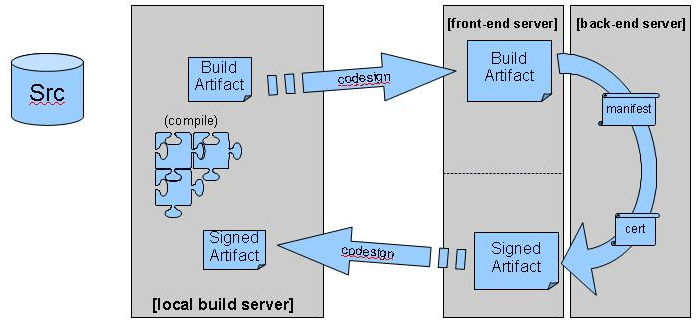
This means that you probably don’t want to maintain the keystore on the build machine, since that machine is likely available to many people. A more secure approach is to introduce a dedicated signing server:

You should also use different signing certificates for development and production.

Timestamping

Certificates are valid for a limited time period only. Any files signed with a private key for which the public key certificate has expired, should no longer be trusted, since it may have been signed after the certificate expired.

We can alleviate this problem by timestamping the file. By adding a trusted timestamp to the file, we can trust it even after the signing certificate expires.

But then how do we trust the timestamp? Well, by signing it using a Time Stamping Authority, of course! The OpenSSL program can help you with that as well.

Beyond Code Signing

When you sign your code, you only prove that the code came from you. For a customer to be able to trust your code, it needs to be trustworthy. You probably want to set up a full-blown Security Development Lifecycle (SDL) to make sure that it is as much as possible.

Another thing to consider in this area is third-party code. Most software packages embed commercial and/or open source libraries. Ideally, those libraries are signed by their authors. But no matter what, you need to take ownership, since customers don’t care whether a vulnerability is found in code you wrote yourself or in a library you used.

Securing Mobile Java Code

Mobile Code is code sourced from remote, possibly untrusted systems, that are executed on your local system. Mobile code is an optional constraint in the REST architectural style.

This post investigates our options for securely running mobile code in general, and for Java in particular.

Mobile Code

Examples of mobile code range from JavaScript fragments found in web pages to plug-ins for applications like FireFox and Eclipse.

Plug-ins turn a simple application into an extensible platform, which is one reason they are so popular. If you are going to support plug-ins in your application, then you should understand the security implications of doing so.

Types of Mobile Code

Mobile code comes in different forms. Some mobile code is source code, like JavaScript.

Mobile code in source form requires an interpreter to execute, like JägerMonkey in FireFox.

Mobile code can also be found in the form of executable code.

This can either be intermediate code, like Java applets, or native binary code, like Adobe’s Flash Player.

Active Content Delivers Mobile Code

A concept that is related to mobile code is active content, which is defined by NIST as

Electronic documents that can carry out or trigger actions automatically on a computer platform without the intervention of a user.

Examples of active content are HTML pages or PDF documents containing scripts and Office documents containing macros.

Active content is a vehicle for delivering mobile code, which makes it a popular technology for use in phishing attacks.

Security Issues With Mobile Code

There are two classes of security problems associated with mobile code.

The first deals with getting the code safely from the remote to the local system. We need to control who may initiate the code transfer, for example, and we must ensure the confidentiality and integrity of the transferred code.

From the point of view of this class of issues, mobile code is just data, and we can rely on the usual solutions for securing the transfer. For instance, XACML may be used to control who may initiate the transfer, and SSL/TLS may be used to protect the actual transfer.

It gets more interesting with the second class of issues, where we deal with executing the mobile code. Since the remote source is potentially untrusted, we’d like to limit what the code can do. For instance, we probably don’t want to allow mobile code to send credit card data to its developer.

However, it’s not just malicious code we want to protect ourselves from.

A simple bug that causes the mobile code to go into an infinite loop will threaten your application’s availability.

The bottom line is that if you want your application to maintain a certain level of security, then you must make sure that any third-party code meets that same standard. This includes mobile code and embedded libraries and components.

That’s why third-party code should get a prominent place in a Security Development Lifecycle (SDL).

Safely Executing Mobile Code

In general, we have four types of safeguards at our disposal to ensure the safe execution of mobile code:

  • Proofs
  • Signatures
  • Filters
  • Cages (sandboxes)

We will look at each of those in the context of mobile Java code.

Proofs

It’s theoretically possible to present a formal proof that some piece of code possesses certain safety properties. This proof could be tied to the code and the combination is then proof carrying code.

After download, the code could be checked against the code by a verifier. Only code that passes the verification check would be allowed to execute.

Updated for Bas’ comment:
Since Java 6, the StackMapTable attribute implements a limited form of proof carrying code where the type safety of the Java code is verified. However, this is certainly not enough to guarantee that the code is secure, and other approaches remain necessary.

Signatures

One of those approaches is to verify that the mobile code is made by a trusted source and that it has not been tampered with.

For Java code, this means wrapping the code in a jar file and signing and verifying the jar.

Filters

We can limit what mobile content can be downloaded. Since we want to use signatures, we should only accept jar files. Other media types, including individual .class files, can simply be filtered out.

Next, we can filter out downloaded jar files that are not signed, or signed with a certificate that we don’t trust.

We can also use anti-virus software to scan the verified jars for known malware.

Finally, we can use a firewall to filter out any outbound requests using protocols/ports/hosts that we know our code will never need. That limits what any code can do, including the mobile code.

Cages/Sandboxes

After restricting what mobile code may run at all, we should take the next step: prevent the running code from doing harm by restricting what it can do.
We can intercept calls at run-time and block any that would violate our security policy. In other words, we put the mobile code in a cage or sandbox.

In Java, cages can be implemented using the Security Manager. In a future post, we’ll take a closer look at how to do this.

Using a Layered XACML Architecture to Implement Retention

A previous post showed how the security principle of segmentation led to a small adaption of the XACML architecture for use in the cloud.

This post shows how a similar adaptation may be required on-premise.

Segmentation of Retention and Regular Access Control Policies

Even when we don’t live in a cloud world, there may be reasons for segmentation. Take records management, for instance.

Any piece of data that is marked as a record, may not be deleted until after the end of the retention period (at which point it must be deleted).

This is an access control policy that clearly takes precedence over the regular policies.

A similar situation exists with legal holds.

While it’s certainly possible to achieve that with various policy sets and clever policy combining, the principle of segmentation encourages us to take a different approach. We would like to physically separate the policies into different layers, so that they can never interfere with each other.

Segmenting XACML Policies Using Layered Policy Decision Points

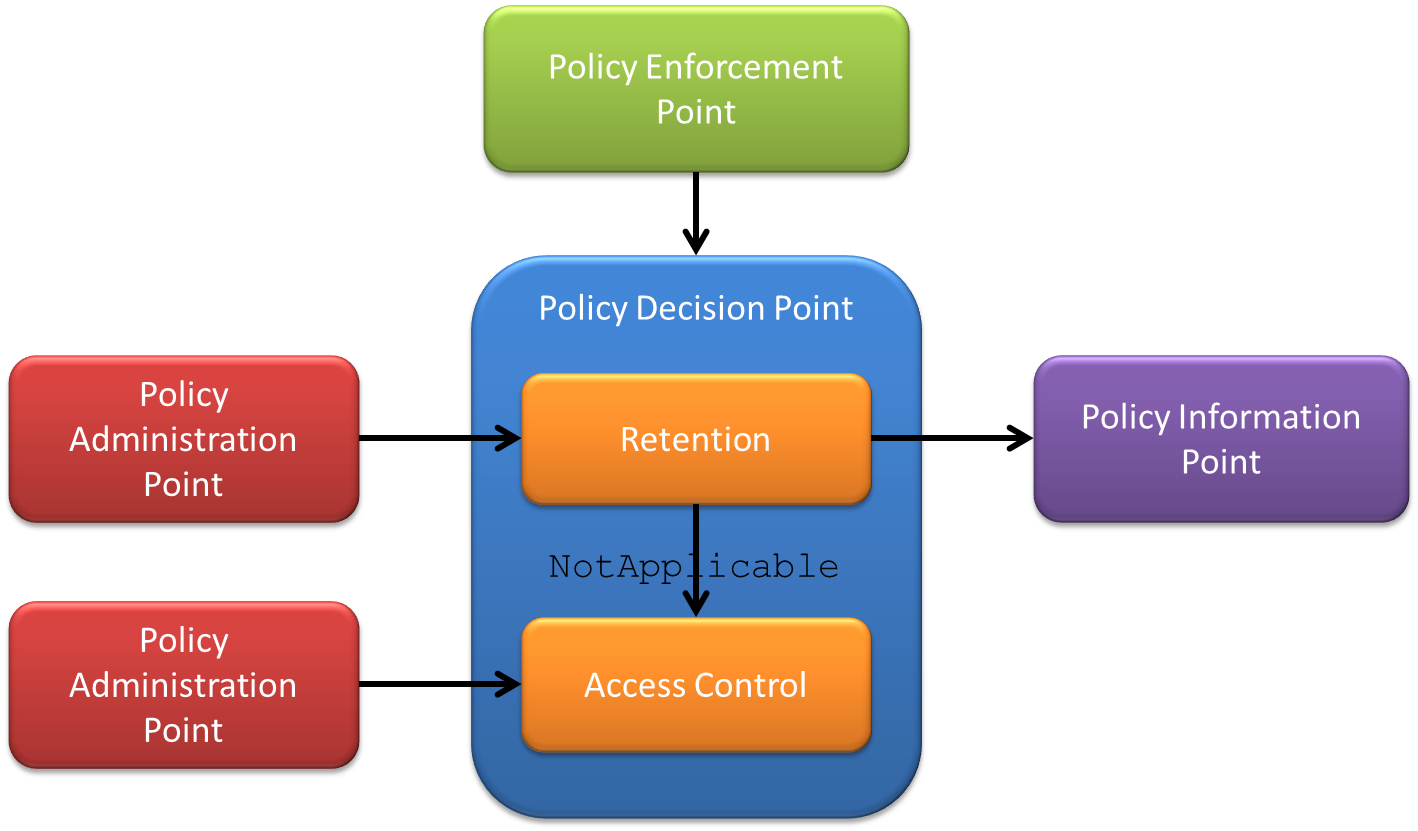
We can create a layered Policy Decision Point (PDP) that wraps smaller PDPs that each deal with a single type of access control policies.

The PDP with retention policies is asked for a decision first. When the decision is NotApplicable it means the resource being accessed is not under retention, and the decision is forwarded to the next PDP, which uses regular access control policies.

The retention policies will probably require a PIP to look up resource attributes, like is-under-retention.

Segmentation Implementation Patterns

While the multi-tenant XACML architecture was an example of a dispatching mechanism, the layered architecture is an example of the Chain of Responsibility pattern.

XACML In The Cloud

The eXtensible Access Control Markup Language (XACML) is the de facto standard for authorization.

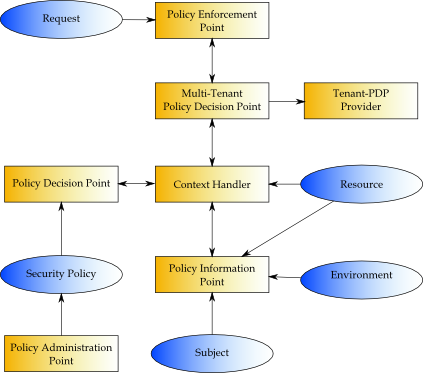
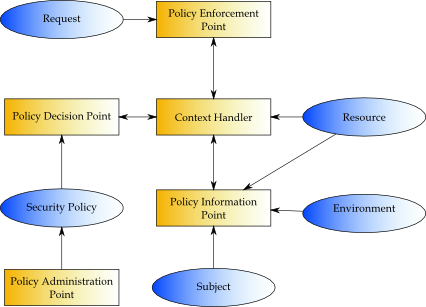
The specification defines an architecture (see image on the right) that relates the different components that make up an XACML-based system.

This post explores a variation on the standard architecture that is better suitable for use in the cloud.

Authorization in the Cloud

In cloud computing, multiple tenants share the same resources that they reach over a network. The entry point into the cloud must, of course, be protected using a Policy Enforcement Point (PEP).

Since XACML implements Attribute-Based Access Control (ABAC), we can use an attribute to indicate the tenant, and use that attribute in our policies.

We could, for instance, use the following standard attribute, which is defined in the core XACML specification: urn:oasis:names:tc:xacml:1.0:subject:subject-id-qualifier.

This identifier indicates the security domain of the subject. It identifies the administrator and policy that manages the name-space in which the subject id is administered.

Using this attribute, we can target policies to the right tenant.

Keeping Policies For Different Tenants Separate

We don’t want to mix policies for different tenants.

First of all, we don’t want a change in policy for one tenant to ever be able to affect a different tenant. Keeping those policies separate is one way to ensure that can never happen.

We can achieve the same goal by keeping all policies together and carefully writing top-level policy sets. But we are better off employing the security best practice of segmentation and keeping policies for different tenants separate in case there was a problem with those top-level policies or with the Policy Decision Point (PDP) evaluating them (defense in depth).

Multi-tenant XACML Architecture

We can use the composite pattern to implement a PDP that our cloud PEP can call.

This composite PDP will extract the tenant attribute from the request, and forward the request to a tenant-specific Context Handler/PDP/PIP/PAP system based on the value of the tenant attribute.

In the figure on the right, the composite PDP is called Multi-tenant PDP. It uses a component called Tenant-PDP Provider that is responsible for looking up the correct PDP based on the tenant attribute.

Abuse Cases

Gary McGraw describes several best practices for building secure software. One is the use of so-called abuse cases. Since his chapter on abuse cases left me hungry for more information, this post examines additional literature on the subject and how to fit abuse cases into a Security Development Lifecycle (SDL).
Modeling Functional Requirements With Use Cases

Abuse cases are an adaptation of use cases, abstract episodes of interaction between a system and its environment.

A use case consists of a number of related scenarios. A scenario is a description of a specific interaction between the system and particular actors. Each use case has a main success scenario and some additional scenarios to cover variations and exceptional cases.

Actors are external agents, and can be either human or non-human.

For better understanding, each use case should state the goal that the primary actor is working towards.

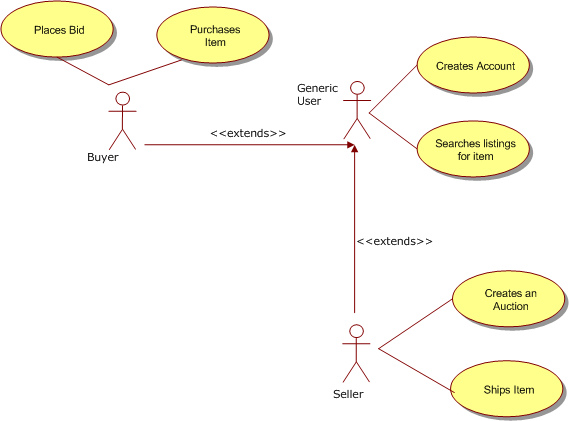
Use cases are represented in UML diagrams (see example on left) as ovals that are connected to stick figures, which represent the actors. Use case diagrams are accompanied by textual use case descriptions that explain how the actors and the system interact.

Modeling Security Requirements With Abuse Cases

An abuse case is a use case where the results of the interaction are harmful to the system, one of the actors, or one of the stakeholders in the system. An interaction is harmful if it decreases the security (confidentiality, integrity, or availability) of the system.

Abuse cases are also referred to as misuse cases, although some people maintain they’re different. I think the two concepts are too similar to treat differently, so whenever I write “abuse case”, it refers to “misuse case” as well.

Some actors in regular use cases may also act as attacker in an abuse case (e.g. in the case of an insider threat). We should then introduce a new actor to avoid confusion (potentially using inheritance). This is consistent with the best practice of having actors represent roles rather than actual users.

Attackers are described in more detail than regular actors, to make it easier to look at the system from their point of view. Their description should include the resources at their disposal, their skills, and their objectives.

Note that objectives are longer term than the (ab)use case’s goal. For instance, the attacker’s goal for an abuse case may be to gain root privileges on a certain server, while her objective may be industrial espionage.

Abuse cases are very different from use cases in one respect: while we know how the actor in a use case achieves her goal, we don’t know precisely how an attacker will break the system’s security. If we would, we would fix the vulnerability! Therefore, abuse case scenarios describe interactions less precisely than regular use case scenarios.

Modeling Other Non-Functional Requirements

Note that since actors in use cases needn’t be human, we can employ a similar approach to abuse cases with actors like “network failure” etc. to model non-functional requirements beyond security, like reliability, portability, maintainability, etc.

For this to work, one must be able to express the non-functional requirement as an interactive scenario. I won’t go into this topic any further in this post.

Creating Abuse Cases

Abuse case models are best created when use cases are: during requirements gathering. It’s easiest to define the abuse cases after the regular use cases are identified (or even defined).

Abuse case modeling requires one to wear a black hat. Therefore, it makes sense to invite people with black hat capabilities, like testers and network operators or administrators to the table.

The first step in developing abuse cases is to find the actors. As stated before, every actor in a regular use case can potentially be turned into an malicious actor in an abuse case.

We should next add actors for different kinds of intruders. These are distinguished based on their resources and skills.

When we have the actors, we can identify the abuse cases by determining how they might interact with the system. We might identify such malicious interactions by combining the regular use cases with attack patterns.

We can find more abuse cases by combining them systematically and recursively with regular use cases.

Combining Use Cases and Abuse Cases

Some people keep use cases and abuse cases separate to avoid confusion. Others combine them, but display abuse cases as inverted use cases (i.e. black ovals with white text, and actors with black heads).

The latter approach makes it possible to relate abuse cases to use cases using UML associations. For instance, an abuse case may threaten a use case, while a use case might mitigate an abuse case. The latter use case is also referred to as a security use case. Security use cases usually deal with security features.

Security use cases can be threatened by new abuse cases, for which we can find new security use cases to mitigate, etc. etc. In this way, a “game” of play and counterplay enfolds that fits well in a defense in depth strategy.

We should not expect to win this “game”. Instead, we should make a good trade-off between security requirements and other aspects of the system, like usability and development cost. Ideally, these trade-offs are made clearly visible to stakeholders by using a good risk management framework.

Reusing Abuse Cases

Use cases can be abstracted into essential use cases to make them more reusable. There is no reason we couldn’t do the same with abuse cases and security use cases.

It seems to me that this not just possible, but already done. Microsoft’s STRIDE model contains generalized threats, and its SDL Threat Modeling tool automatically identifies which of those are applicable to your situation.

Conclusion

Although abuse cases are a bit different from regular use cases, their main value is that they present information about security risks in a format that may already be familiar to the stakeholders of the software development process. Developers in particular are likely to know them.

This should make it easier for people with little or no security background to start thinking about securing their systems and how to trade-off security and functionality.

However, it seems that threat modeling gives the same advantages as abuse cases. Since threat modeling is supported by tools, it’s little wonder that people prefer that over abuse cases for inclusion in their Security Development Lifecycle.

XACML Vendor: Axiomatics

This is the second in a series of posts where I interview XACML vendors. This time it’s Axiomatics’ turn. Their CTO Erik Rissanen is editor of the XACML 3.0 specification.

Why does the world need XACML? What benefits do your customers realize?

The world needs a standardized way to externalize authorization processing from the rest of the application logic – this is where the XACML standard comes in. Customers have different requirements for implementing externalized authorization and, therefore, can derive different benefits.

Here are some of the key benefits we have seen for customers:

  • The ability to share sensitive data with customers, partners and supply chain members
  • Implement fine grained authorization at every level of the application – presentation, application, middleware and data tiers
  • Deploy applications with clearly audit-able access control
  • Build and deploy applications and services faster than the competition
  • Move workloads more easily to the most efficient compute, storage or data capacity
  • Protect access to applications and resources regardless of where they are hosted
  • Implement access control consistently across all layers of an application as well as across application environments deployed on different platforms
  • Exploit dynamic access controls that are much more flexible than roles

What products do you have in the XACML space?

Axiomatics has three core products today:

  • The Axiomatics Policy Server which is a modular XACML-driven authorization server. It fully implements XACML 2.0 and XACML 3.0 and respects the XACML architecture.
  • The Axiomatics Policy Auditor which is a web-based product administrators and business users alike can use to analyze XACML policies to identify security gaps or create a list of entitlements. Generally, the auditor helps answer the question “How can an access be granted?”
  • The Axiomatics Reverse Query takes on a novel approach to authorization. Where one typically creates binary requests (Can Alice do this?) and the Axiomatics Policy Server would reply with a Yes or No, the Axiomatics Reverse Query helps invert the process to tackle the list question. We have noticed that our customers sometimes want to know the list of users that have access to an application or the list of resources a given user can access. This is what we call the list question or reverse querying.
    The Axiomatics Reverse Query is an SDK that requires integration with a given application. With this in mind, Axiomatics engineering have developed extra glue / integration layers to plug into target environments and products. For instance, Axiomatics will release shortly the Axiomatics Reverse Query for Oracle Virtual Private Database. Axiomatics also uses the SDK to drive authorization inside Windows Server 2012. And there are many more integration options we have yet to explore.

In addition, Axiomatics has now released a free tool and a new language called ALFA, the Axiomatics Language for Authorization. ALFA is a lightweight version of XACML with shorthand notations. It borrows much of its syntax from programming languages developers are most familiar with e.g. Java and C#. The tool is a free plugin for the Eclipse IDE which lets developers author ALFA using the usual Eclipse features such as syntax checking and auto-complete. The plugin eventually generates XACML 3.0 conformant policies on the fly from the ALFA the developers write. Axiomatics published a video on its YouTube channel showing how to use the tool.

What versions of the spec do you support? What optional parts? What profiles?

Axiomatics fully supports XACML 2.0 and XACML 3.0 including all optional profiles as specified in our attestation email.

What sets your product(s) apart from the competition?

Axiomatics has historically been what we could call a pure play XACML vendor. This reflects our dedication to the standard and the fact that Axiomatics implements the XACML core and all profiles – no other vendor has adopted such a comprehensive strategy. Furthermore, Axiomatics only uses the XACML policy language, rather than attempting to convert between XACML and one or more proprietary, legacy policy language formats. The comprehensiveness of the XACML policy language gives customers the most flexibility – as well as interoperability – across a multitude of applications and usage scenarios.

This also made Axiomatics a very generic solution for all things fine-grained authorization. This means the Axiomatics solution can be applied to any type of application, in particular .NET or J2SE/J2EE applications but also increasingly COTS such as SharePoint and databases such as Oracle VPD.

Axiomatics also leverages the key benefits of the XACML architecture to provide a very modular set of products. This means our core engine can be plugged into a various set of frameworks extremely easily: the authorization engine can be embedded or exposed as a web service (SOAP, REST, Thrift…). It also means our products scale extremely well and allow for a single point of management with literally hundreds of decision points and as many enforcement points. This makes our product the fastest, most elegant approach to enterprise authorization.

Axiomatics’ auditing capablities are quite unique too: with the Policy Auditor, it is possible to know what could possibly happen, rather a simple audit of what did actually happen. This means it is easier than ever to produce reports that will keep auditors satisfied the enterprise is correctly protected.

Lastly, Axiomatics has over 6 years experience in the area and is always listening to its customers. As a result, new products have been designed to better address customer needs. One such example is our Axiomatics Reverse Query which reverses the authorization process to be able to tackle a new series of authorization requirements our customers in the financial sector had. Instead of getting yes/no answers, these customers wanted a list of resources a user can access (e.g. a list of bank accounts) or a list of employees who can view a given piece of information. By actively listening to our customers we are able to deliver new innovative products that best match their needs.

What customers use your product(s)? What is your biggest deployment?

Axiomatics has several Fortune 50 customers. Some of the world’s largest banks and enterprises are Axiomatics customers. Axiomatics customers are based in the US and Europe mainly. One famous customer where Axiomatics is used intensively is PayPal. It is probably Axiomatics’ current biggest deployment in terms of transactions.

A US-based bank has also deployed Axiomatics products across three continents in order to protect trading applications.

What programming languages do you support? Will you support the upcoming REST and JSON profiles?

Axiomatics supports Java and C#. Axiomatics has been used in customer deployments with other languages such as Python.

Axiomatics is active in defining the new REST profile of the XACML TC and will try to align with it as much as possible. Axiomatics is also leading the design of a JSON-based PEP-PDP interaction. JSON as well as Thrift are likely to be the next communication protocols supported.

Do you support OpenAz? Spring Security? Other open source efforts?

Axiomatics does not currently support OpenAZ but has been watching the specification in order to eventually take part. Axiomatics already supports Spring Security. In addition, there is a new open source initiative aimed at defining a standard PEP API which Axiomatics and other vendors are taking part in.

How easy is it to write a PEP for your product(s)? And a PIP? How long does an implementation of your product(s) usually take?

Should customers decide to write a custom PEP rather than use an off-the-shelf PEP, they can use a Java or C# SDK to quickly write PEPs. Axiomatics has published a video explaining how to write a PEP in 5 minutes and 20 lines of code.

An implementation of our product can take from 1 week to 3 months or more depending on the customer requirements, the complexity of the desired architecture, and the number of integration points.

Can your product(s) be embedded (i.e. run in-process)?

The Axiomatics PDP can be embedded. Customers sometimes choose this approach to achieve even greater levels of performance.

What optimizations have you made? Can you share performance numbers?

There are many factors such as number of policies, complexity of policies, number of PIP look-ups and others that have an effect on performance. One of our customers shared the result of their internal product evaluation where they reached 30.000 requests per second.

The Axiomatics PDP is also used to secure transactions for several hundred million users and protect the medical records of all 9 million Swedish citizens.